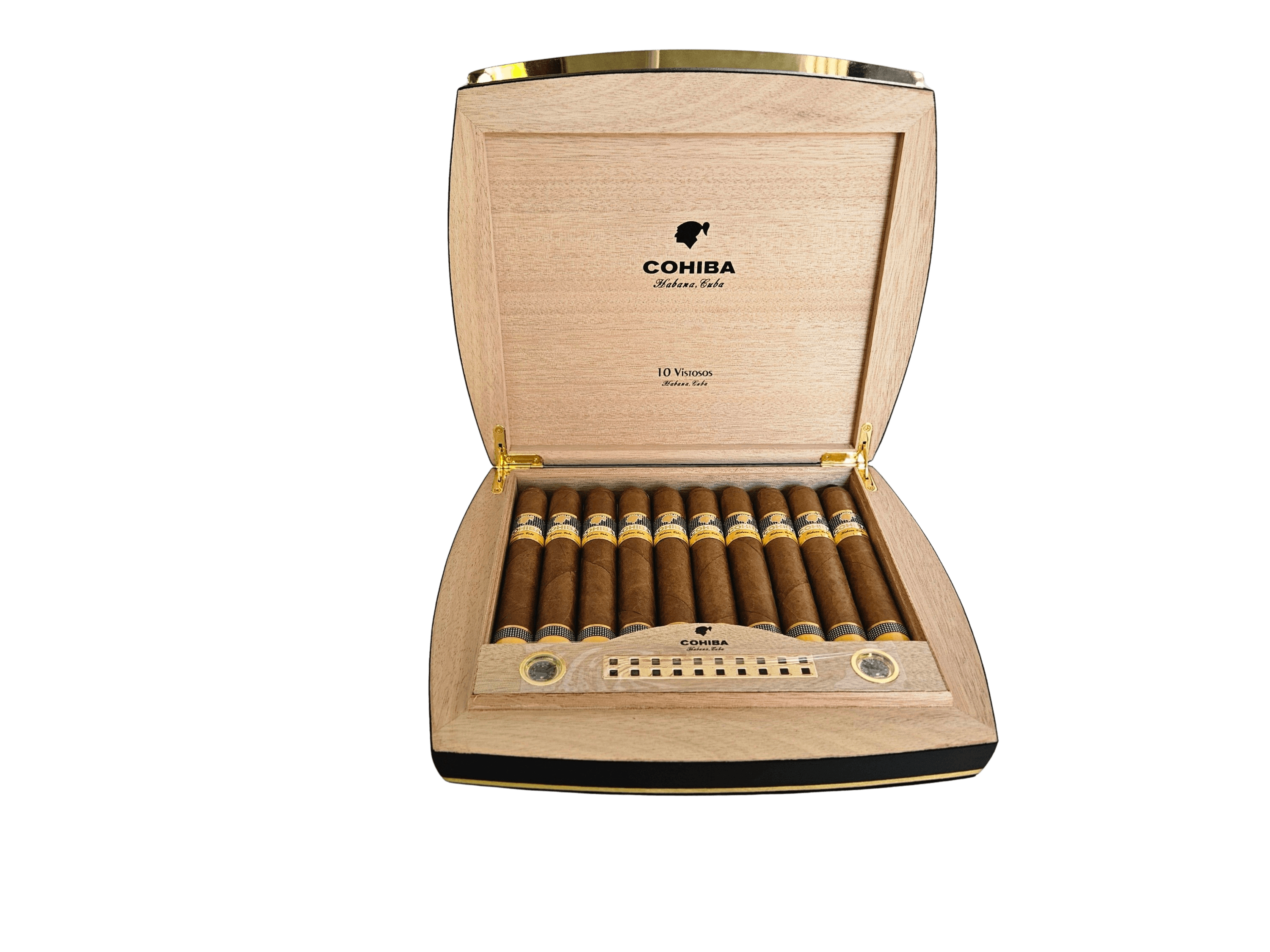
A humidor keeps cigars in a stable climate. Three factors are decisive: a relative humidity in the range of roughly 65 to 72%, a temperature that is as constant as possible, and a gauge you can trust. This article describes how a new humidor is prepared, set up and looked after day to day.
What humidity does a Habano need?
Habanos S.A. specifies a relative humidity of 65 to 70% at 16 to 18 °C for storage. Values of up to around 72% are common in wooden humidors, because the wood absorbs some of the moisture and the air inside is therefore slightly drier than the humidity source.
According to Habanos S.A., humidity is the most important factor: a cigar that is too moist draws and burns poorly, while a dried-out one tastes harsh. If a cigar stays too dry for several months, aromas are lost permanently. Within the stated range, the choice is a matter of personal preference: lower values give an easier draw, higher values a slightly fuller, slower-burning cigar.
Why does a new humidor need to be seasoned?
New cedar wood is kiln-dried and draws moisture from its surroundings. Without preparation, it would pull this moisture out of the cigars placed inside.
During seasoning, the wood is first brought into equilibrium with the target humidity:
- Wipe the cedar interior surfaces, including the lid, trays and dividers, with a clean, only slightly damp cloth or sponge. The wood should absorb moisture but not get wet; too much water can warp the wood.
- Use distilled water for this. Tap water leaves mineral deposits.
- Fill the humidifier, also place a small container of distilled water inside and close the lid.
- Check the reading daily. Only once the humidity has remained stable within the target range for a few days is the humidor ready. The water container is then removed.
How can you check whether the hygrometer is accurate?
With the salt test: a saturated solution of table salt produces a relative humidity of 75% in a sealed container. If the hygrometer shows a different value, you know its deviation.
- Put a teaspoon of table salt into a bottle cap or a small dish and moisten it with a few drops of water, so that the salt does not dissolve.
- Place the salt and the hygrometer together in a tightly closing, transparent container or a sealed zip bag.
- Wait at least six hours and read the value without opening the container.
- Note the difference from 75%. If the device shows 70%, the actual humidity is 5 percentage points higher than displayed.
Analogue hygrometers can often be adjusted using a screw on the back. With digital devices that cannot be adjusted, you simply factor in the deviation. Repeating the test at regular intervals shows whether the device drifts over time.
What types of humidification are there?
Two systems are widespread: passive humidifiers filled with distilled water or a propylene glycol solution, and ready-made humidity packs with a fixed target value.
Distilled water and PG solution
Classic humidifiers contain a sponge, foam or granules. A 50:50 mixture of propylene glycol and distilled water acts as a buffer and keeps the humidity at around 70%. The humidifier is often filled with this solution at the start and then topped up with distilled water, with the PG solution only being used every few months.
Humidity packs
Two-way humidity packs based on salt and water release moisture when the air is too dry and absorb it when it is too humid. They are available with fixed values, such as 65, 69 or 72%. The higher value compensates for the fact that wooden humidors absorb a few percentage points of moisture. According to the manufacturers, they last around two to four months in a wooden humidor and six to nine months in an airtight container.
What role does temperature play?
The temperature should remain as constant as possible, because relative humidity changes along with it. Habanos S.A. specifies 16 to 18 °C as the storage temperature.
A second reason is the tobacco beetle (Lasioderma serricorne). It feeds on tobacco and bores holes in the wrapper. Habanos S.A. gives 18 °C as a value that should not be exceeded in the humidor and, by its own account, has frozen all Habanos in its Havana warehouses before shipment since 2005. Direct sunlight, radiators and exterior walls therefore make for unsuitable locations.
Why are cigars rotated in the humidor?
The climate inside a humidor is not the same everywhere. Cigars close to the humidifier are kept moister than those in a far corner or in the bottom layer.
Rotating the cigars every few weeks, that is, swapping the upper and lower layers and switching front and back, evens out these differences. It is also a good moment to check the cigars for holes, stains or changes to the wrapper.
What are common mistakes?
Most problems are caused by unchecked readings and too much water.
- No seasoning: dry cedar wood draws moisture from freshly stored cigars.
- Uncalibrated hygrometer: a deviation of several percentage points goes unnoticed without a salt test.
- Tap water: minerals build up in the humidifier and impair its function.
- Wood that is too wet: a dripping-wet sponge during seasoning can warp the cedar lining.
- Frequent opening: every opening lets moist air escape; the humidor then needs time to settle again.
- Overfilling: tightly packed cigars leave little room for air to circulate, and the climate becomes uneven.
- Unsuitable location: heat sources and sunlight constantly change temperature and humidity.
How does smoke.ch store its cigars?
smoke.ch stores its cigars at 70% relative humidity in cedar wood. This places its storage within the range Habanos S.A. specifies for Habanos.